


What Is the Best Creatine? Powder vs Capsules vs Chewables
By James Lai, Certificate IV in Fitness (Personal Training) · Published 20 October 2026 · 9 min read
Quick answer: For most healthy adults considering creatine, creatine monohydrate is the evidence-backed default. Powder, capsules and chewables can deliver monohydrate in different formats, so the best practical choice depends on the labelled daily serve, convenience, taste, portability and cost. Compare current labels and follow the directions for the exact product. 1,2
How to choose a creatine product that fits your routine
The best creatine product is not automatically the one with the newest name, the most claims or the biggest tub. A more useful buying process separates the form of creatine from the format used to deliver it.
Creatine form: The chemical form of creatine in the product, such as creatine monohydrate.
Delivery format: How the ingredient is supplied, such as powder, capsules or chewable tablets.
Creatine monohydrate has the deepest research base and remains the reference form against which alternatives are commonly assessed. 1,2
That distinction makes the buying decision simpler. First, check the ingredient panel and confirm the creatine form. Next, compare how much the product provides per unit and per labelled daily serve. Then choose the format you can use consistently within the label directions.
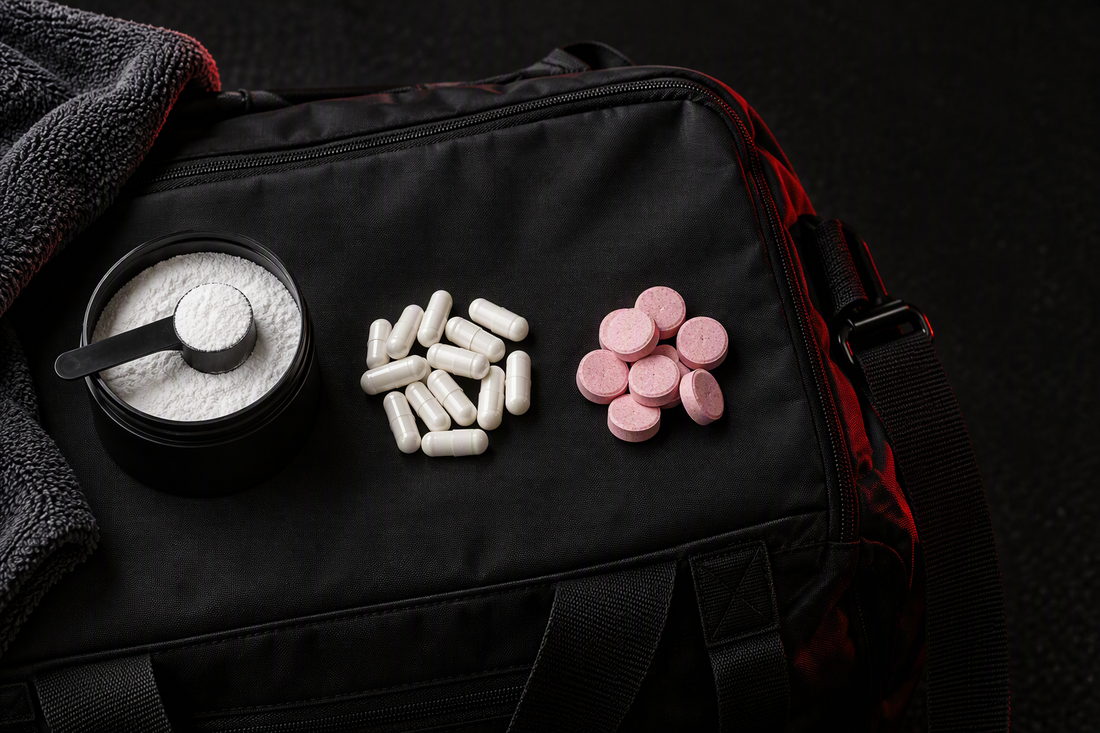
A tub of powder may suit someone who already mixes a daily shake. Capsules can fit easily in a work drawer or training bag. Chewables may suit someone who prefers not to mix powder or swallow several capsules. None of those practical differences proves that one format produces a better training outcome when the underlying ingredient and delivered amount are equivalent.

Why creatine monohydrate is the evidence-backed standard form
The International Society of Sports Nutrition identifies creatine monohydrate as the most extensively studied and clinically effective form. That research covers its ability to increase muscle creatine and support performance in repeated high-intensity exercise in the groups studied. 1
The Australian Institute of Sport describes creatine monohydrate as very well absorbed and notes that most safety and efficacy data relate to monohydrate powder. Its creatine guidance also cautions that alternative forms promoted as having better absorption do not have evidence to support those claims. 3
In a seven-week trial involving 30 non-resistance-trained men, the authors concluded that creatine ethyl ester was not as effective as monohydrate at increasing serum and muscle creatine levels. It also did not improve the measured training outcomes beyond the training program. 4 A 2022 critical review concluded that no other marketed form had been shown to be a more effective source of creatine than monohydrate. 2
Greater solubility, a different salt or a newer product name should therefore not be treated as proof of better absorption, performance or safety. Those outcomes require direct, well-designed comparative evidence.
The AIS classifies creatine within Group A of its Sports Supplement Framework, which covers supplements with strong scientific evidence for use in specific sporting situations under evidence-based protocols. That classification is not a universal recommendation for every person, product or training goal. 3
When consumed as part of a healthy, varied diet with an appropriate training or exercise program.
Creatine powder vs capsules vs chewables
When each product supplies creatine monohydrate, the main differences for a buyer are usually practical. Compare the full label, number of units needed for the daily serve, flavour, portability, storage requirements and current cost per labelled daily serve.
| Comparison point | Powder | Capsules | Chewables |
|---|---|---|---|
| How it is used | Measured and mixed with liquid or food | Swallowed with liquid | Chewed according to label directions |
| Dose control | Flexible measurement, but accurate scooping matters | Fixed amount per capsule | Fixed amount per tablet |
| Routine fit | Useful for home, gym or shake routines | Portable and requires no mixing | Portable and requires no mixing |
| Taste and texture | Depends on flavour and product | Avoids powder taste and texture | Flavoured chewable experience |
| Unit count | Usually one measured serve | May require several capsules | May require several tablets |
| Storage | Keep dry, sealed and within label conditions | Keep in original packaging and follow label | Keep in original packaging and follow label |
| Value check | Price divided by labelled serves | Price divided by complete daily serves | Price divided by complete daily serves |
Cost per tub or bottle is not a reliable comparison by itself. Prices and promotions change, pack sizes differ and a low pack price can conceal a smaller number of complete daily serves. Calculate value from the current purchase price divided by the number of labelled daily serves.
Does creatine expire? Storage and shelf-life checks
Creatine products carry a printed expiry or best-before date and product-specific storage directions. Use those details as the controlling guidance. General evidence about stability should never be used to extend a date printed on a specific product.
Technical reviews report that dry creatine monohydrate is comparatively stable, while creatine in solution is more sensitive to conditions including pH and temperature. 2,5 This helps explain why dry storage matters and why the AIS advises consuming creatine soon after it is mixed. 3
After opening a tub, close it securely and use a dry scoop. Musashi’s creatine powder, capsule and chewable labels all direct storage below 25°C in a cool, dry place. The capsule label also says to discard the contents 3 months after opening. Moisture can contribute to clumping, but clumping, smell or appearance alone cannot show whether a product is still suitable to use. The product date, seal condition and manufacturer guidance come first.
All three labels say not to use the product if the cap ring or the seal under the cap is broken or missing. Also avoid a product whose label or date marking is unreadable, or where contamination is suspected. If the product’s condition or storage history is uncertain, contact the manufacturer with the product name, batch details and date marking.
Where to buy genuine, tested creatine
Start with the brand’s official AU or NZ website or a retailer the brand identifies as authorised. This provides a clearer path to the current label, customer support, batch details, returns process and market-specific product information.
Before buying, check:
- the exact product name and creatine form;
- the labelled amount per unit and complete daily serve;
- the expiry or best-before information when visible;
- the seal and packaging condition on arrival;
- the seller’s identity and contact details;
- whether any testing, ingredient-source or certification statement applies to that exact SKU and market.
Be cautious with listings that omit the full label, use inconsistent product images or make superiority claims without comparative evidence. A marketplace listing may be fulfilled by a third-party seller rather than the brand itself, so check who is actually supplying the product.
Travelling with creatine powder, capsules or chewables
For flights within Australia, the Australian Border Force states that there is no general restriction on the quantity of powders, liquids, aerosols and gels carried on domestic flights. Limits apply when a domestic flight departs from an international terminal. For international flights entering or leaving Australia, certain powders are restricted, powders may need to be presented separately, and screening officers have the final decision. 6
Australian guidance distinguishes organic and inorganic powders but does not specifically classify creatine powder. 6
Rules also vary by country, airport, airline and itinerary. Before departure, check the official requirements for each departure, transit and arrival point. Keep supplements in their original, clearly labelled packaging. A larger tub may be simpler in checked baggage, but airline, destination and biosecurity requirements still apply.
Capsules or chewables reduce the mess of carrying loose powder. Avoid transferring white powder into an unmarked bag because it removes the identifying product information a screening officer may need.
Musashi creatine format selector
Musashi offers creatine monohydrate in powder, capsule and chewable formats, and the amount of creatine in each labelled serve differs by format. Musashi Creatine Monohydrate Powder is a Fuel-system powder made with creatine monohydrate. It comes in Unflavoured (350 g and 600 g), Berry (420 g) and Blue Raspberry (420 g), with 5 g of creatine monohydrate per serve. Musashi Creatine Capsules provide 500 mg of creatine monohydrate per capsule, or 3 g in the labelled daily serve of six capsules, with 120 capsules per bottle. Musashi Creatine Chewables provide 1,000 mg of Creapure® creatine monohydrate per tablet, or 3 g in the labelled daily serve of three tablets, in a 60-tablet Berry pack.
| Your priority | Format to consider | Check before purchase |
|---|---|---|
| Flexible mixing at home or the gym | Musashi Creatine Monohydrate Powder | Current ingredient panel, flavour, pack size, scoop and label directions |
| No mixing and easy training-bag storage | Musashi Creatine Capsules | Amount per capsule and current capsule count per daily serve |
| A flavoured, no-mix option | Musashi Creatine Chewables | Current Creapure® statement, flavour, tablet count and daily serve |
| Travel convenience | Capsules or chewables | Route rules and original labelled packaging |
| Value comparison | Any format | Current price divided by labelled daily serves, not pack price alone |
This table is a routine selector, not a clinical ranking. It does not claim that one Musashi format is more effective than another. Follow the directions on the product label. For dosing and timing, see How to Take Creatine: Dosage, Timing & Method.
Always read the label. Use only as directed. Supplementary to and not a replacement for a balanced diet.
Key takeaways about the best creatine form
- Creatine monohydrate has the strongest established evidence base among creatine forms. 1,2
- Powder, capsules and chewables are delivery formats, not proof of different efficacy.
- Compare current labels, complete daily serves, convenience and cost per labelled serve.
- Follow the exact product’s expiry, storage directions and pack instructions.
- Buy through official or authorised channels and verify claims for the exact SKU.
- Check official travel rules for every airport, airline and destination before packing supplements.
Frequently asked questions about creatine products and forms
What is the best form of creatine?
Creatine monohydrate is the evidence-backed default because it is the most extensively studied form, and reviews have not established another form as a more effective source of creatine. Powder, capsules and chewables may all deliver monohydrate, so compare the verified daily serve, convenience, taste, portability and current cost per labelled serve. 1,2
Does creatine powder expire?
Yes. Use the expiry or best-before date and storage instructions printed on the exact product. Dry creatine monohydrate is comparatively stable in published reviews, but that does not override a manufacturer’s date, damaged seal or product-specific direction. Contact the manufacturer if the batch marking, appearance or storage history creates doubt. 2,5
Where should I buy creatine?
Buy from the brand’s official market website or an authorised retailer with clear seller details, intact packaging and current label information. Verify any batch-testing, certification, ingredient-source or manufacturing claim for the exact SKU. Do not assume a claim attached to one product automatically applies to every creatine product in the range.
Can I travel with creatine powder?
Creatine powder may be carried subject to the rules for your route, airport and airline. Australian domestic flights generally have no powder quantity restriction unless departing from an international terminal, while international screening rules differ and officers have final discretion. Check official rules before each trip and keep the supplement clearly labelled. 6
References
- Kreider, R. B., Kalman, D. S., Antonio, J., Ziegenfuss, T. N., Wildman, R., Collins, R., Candow, D. G., Kleiner, S. M., Almada, A. L., & Lopez, H. L. (2017). International Society of Sports Nutrition position stand: Safety and efficacy of creatine supplementation in exercise, sport, and medicine. Journal of the International Society of Sports Nutrition, 14, 18. DOI record.
- Kreider, R. B., Jäger, R., & Purpura, M. (2022). Bioavailability, efficacy, safety, and regulatory status of creatine and related compounds: A critical review. Nutrients, 14(5), 1035. DOI record.
- Australian Institute of Sport. (n.d.). Creatine. AIS Sports Supplement Framework. Australian Sports Commission creatine guidance.
- Spillane, M., Schoch, R., Cooke, M., Harvey, T., Greenwood, M., Kreider, R., & Willoughby, D. S. (2009). The effects of creatine ethyl ester supplementation combined with heavy resistance training on body composition, muscle performance, and serum and muscle creatine levels. Journal of the International Society of Sports Nutrition, 6, 6. DOI record.
- Jäger, R., Purpura, M., Shao, A., Inoue, T., & Kreider, R. B. (2011). Analysis of the efficacy, safety, and regulatory status of novel forms of creatine. Amino Acids, 40, 1369–1383. DOI record.
- Australian Border Force. (n.d.). What can you bring on a plane? Australian Government. Australian Border Force guidance.
The information in this article is for educational purposes only and is not intended as medical advice. Always read the label and follow the directions for use. If symptoms persist, consult your healthcare professional. Musashi products are formulated for healthy adults; consult a healthcare professional before use if you have a pre-existing medical condition, are pregnant or breastfeeding, or are taking medication.