


Is Creatine Good for You? Who Should (and Shouldn't) Take It
By Jelena Savic, BHSc (Naturopathy) · Published 26 November 2026 · 8 min read
Quick answer: Creatine monohydrate can be useful for healthy adults doing resistance training or repeated high-intensity exercise, but it's optional, not essential. Research generally reports that it's well tolerated in studies. Benefits vary. If you have a medical condition, take medication, or are pregnant or breastfeeding, you should get individual healthcare advice before starting. 1–3,10
Is creatine good for you, or just useful for certain goals?
Creatine can be useful, but “good for you” is too broad for a simple yes. The clearest case is a healthy adult whose training involves lifting, sprinting or repeated hard efforts. That's different from saying everyone needs a creatine supplement for general health. 1,2
If you train three times a week, don't ask whether you're advanced enough. Ask whether your sessions and goals match the activities creatine has been studied to support.
Phosphocreatine: A stored form of creatine that helps your muscles quickly regenerate ATP (adenosine triphosphate), the energy carrier your muscles use to contract. Taking creatine can increase muscle creatine stores and support this system during brief, intense exercise. 1,2
Our guide to what creatine is and how it works explains the mechanism in more detail. This article is about whether it matters for your decision.
Who benefits most from taking creatine?
The strongest practical fit is resistance training and repeated high-intensity exercise. Diet and life stage can also matter, but they don't give a simple ranking of who will respond best. 1,2,4,5
Can strength, power and team-sport athletes benefit?
If you're a healthy adult who lifts weights or does repeated sprints, you have a clear reason to consider creatine. A meta-analysis pools the results of many trials. A 2024 meta-analysis of adults under 50 found greater upper- and lower-body strength gains with creatine plus resistance training than with placebo plus resistance training. 4
For team sports, what matters is repeated bursts of effort, not the sport itself. Sprinting, jumping and repeated hard work match the energy demands described in sports-nutrition guidance. That doesn't guarantee better match performance or a particular result for every athlete. 1,2
Is creatine particularly relevant for vegetarians?
Vegetarians often have lower muscle creatine stores because meat and fish are major dietary sources. A systematic review found that taking creatine increased creatine stores in vegetarian participants. But findings were mixed on whether their performance improved more than in meat-eaters (omnivores). The studies in the review also had a moderate-to-high risk of bias. 5
So if you're vegetarian and lift regularly, you may have a relevant reason to consider creatine. Being vegetarian alone doesn't make creatine a must, or mean you have a deficiency that needs treating.
Can older adults benefit from creatine?
Research in older adults has mainly looked at creatine alongside resistance training. An earlier meta-analysis reported extra gains in muscle mass and some strength measures. A 2026 analysis found modest extra strength benefits. But its pooled results for muscle mass and physical function weren't statistically significant. 6,7
Creatine may complement resistance training for some older adults. It shouldn't be seen as a way to prevent ageing or guarantee better everyday function. The newer analysis also warned against applying its findings to frail older adults or those with limited physical function. 6

Who might not need creatine?
Creatine is optional, even when your training matches the evidence. You can skip it and still work towards strength or muscle goals through resistance training. Trials comparing creatine with a placebo (a dummy supplement) test an add-on to training, not something training needs to work. 4,9
Creatine may be a lower priority if your main activity is steady-paced endurance exercise. A meta-analysis of 13 studies in trained participants found no significant pooled improvement in endurance performance. Creatine may still have a role in some endurance training, particularly where repeated hard efforts are involved. 8
| Decision point | Creatine may be relevant | Creatine may be a lower priority |
|---|---|---|
| Main training demand | Resistance training or repeated high-intensity efforts 1,4 | Predominantly steady-paced endurance exercise 8 |
| Desired outcome | Additional support for strength-training adaptations 4 | A general-health benefit without a defined training goal |
| Expectations | An optional addition with variable results 2,4 | An instant boost or guaranteed physique change 2,3 |
Use the table as a starting point. It isn't a medical screening tool or a prediction of how your body will respond. 1–4,8
Is creatine safe for beginners?
Reviews generally describe creatine monohydrate as well tolerated by healthy adults in studies. Being new to the gym doesn't, on its own, tell you whether creatine suits you. Your health, the product directions and how your body responds matter more than whether you call yourself a beginner. 2,3,10
Side effects can still happen. Some users experience digestive discomfort, and early body-water changes can affect scale weight. Our guide to creatine side effects, safety and digestive health explains those concerns in more detail. 3,10
If you're a beginner, start with your training goal. Then check whether creatine suits you and read the exact label before you decide. A sports dietitian can help you fit creatine into your wider training and nutrition plan. 1
What results can you realistically expect from creatine?
Think of creatine as possible support for repeated training, not an instant change. It works by increasing the creatine available in your muscles. It doesn't give you a caffeine-like feeling after one serve. 1–3
Research supports extra strength gains with resistance training and, in some analyses, bigger gains in lean body mass. Lean body mass includes water and other non-fat tissues; it is not a direct measurement of newly built muscle. So don't treat early water changes and longer-term training gains as the same thing. 3,4,9
Study averages don't predict your individual result. So no one can reliably promise you a set number of extra repetitions, kilograms on a lift or centimetres on your muscles. Your training, how you take creatine and how your body responds all play a part. 2,4
If you decide to use creatine, a training log helps keep your expectations realistic. Record the exercise, load and repetitions, and don't treat a change on the scale as proof of progress. Our guide to the benefits of creatine separates well-supported exercise findings from less certain ones.
Who should check with a doctor before taking creatine?
Seek individual healthcare advice before starting if you have a medical condition, particularly kidney or liver concerns, take medication, or are pregnant or breastfeeding. Research in healthy adults can't show whether creatine suits you in those situations. 10,11
If you've had abnormal blood-test results or have a kidney-function test coming up, tell your doctor about any creatine you take. Taking creatine can affect creatinine, a marker used to check kidney function. An abnormal result still needs a doctor to interpret it. 14 Our guide to creatine, kidney and liver health covers that distinction.
This article covers adults 18 and over. Our guide to creatine for women, teens and older adults explains why teenage, pregnancy and older-adult decisions need their own context.
Checking first doesn't mean creatine is unsuitable for you. It just means a general article can't make that call for you.
What should you check when choosing a creatine format?
Musashi offers creatine monohydrate in powder, capsule and chewable formats, and the amount of creatine in each labelled serve differs by format. 13
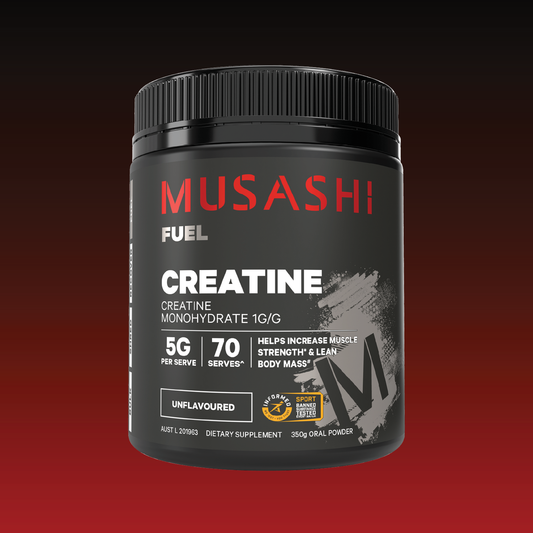
Musashi Creatine Monohydrate Powder is 100% creatine monohydrate in its Unflavoured version. It comes in Unflavoured (350 g and 600 g), Berry (420 g) and Blue Raspberry (420 g), with 5 g of creatine monohydrate per serve. 12
Each serve has 5 g of creatine monohydrate, equivalent to 4.4 g of creatine. The Unflavoured serve is 5 g of powder, while the Berry serve is 6 g, so powder weight and creatine amount aren't the same thing in flavoured versions. 12
The powder is Informed Sport certified, which means every batch is tested for banned substances before release. 12 Batch testing lowers contamination risk. But it doesn't show that a product suits you medically, or removes all supplement risk. 11
Follow the directions on your exact pack, not a dose copied from a research study. Our guide on how to take creatine explains dosage and timing, and how research doses differ from product directions.
Key takeaways about whether creatine is good for you
- Creatine is optional. It fits best with resistance training and repeated high-intensity effort. 1,4
- Creatine is generally well tolerated by healthy adults in studies, but that doesn't mean it suits everyone. 3,10
- Vegetarians may have lower creatine stores, but bigger performance gains aren't guaranteed. 5
- For older adults, strength findings are encouraging. Extra muscle mass and better everyday function are less certain. 6,7
- If you have a medical condition, take medication, or are pregnant or breastfeeding, get individual healthcare advice first. 10,11
Frequently asked questions about whether creatine is good for you
Is creatine safe for beginners?
Creatine monohydrate is generally described as well tolerated by healthy adults in studies. But being a beginner doesn't tell you whether it suits you. Check the exact product directions. Get healthcare advice first if you have a medical condition, take medication, or are pregnant or breastfeeding. Digestive discomfort and early body-water changes can occur. 2,3,10
Do you need creatine to build muscle?
Creatine is not a requirement for building muscle through resistance training. Research looks at whether adding creatine improves results compared with training without it. Some analyses report extra strength and lean-body-mass gains. But that doesn't make creatine essential or guarantee a particular physique. Lean-body-mass measurements also include water, not just muscle. 3,4,9
Is creatine worth it if I train three times a week?
Creatine may be worth considering if those sessions involve resistance training or repeated high-intensity efforts. Three sessions a week isn't a proven threshold for benefit. The type of exercise, your goal and whether creatine suits you matter more. For mostly steady-paced endurance exercise, a meta-analysis found no significant pooled improvement in endurance performance in trained people. 1,4,8
Do vegetarians need creatine supplements?
Vegetarians don't automatically need creatine supplements. They often have lower muscle creatine stores, and taking creatine can increase those stores. But a systematic review found mixed evidence on whether their performance improved more than in meat-eaters, with limits in study quality. Your training goals and whether creatine suits you should guide the decision, not being vegetarian alone. 5
Who should check with a doctor before taking creatine?
Before starting creatine, you should get individual healthcare advice if you have a medical condition, particularly kidney or liver concerns, take medication, or are pregnant or breastfeeding. Tell your doctor you take creatine if blood tests are planned or your results are abnormal. Research in healthy adults can't show whether creatine suits you in these situations, and it can't replace a doctor's interpretation of your results. 10,11
References
- Australian Institute of Sport. (n.d.). Creatine. Australian Sports Commission.
- Kreider, R. B., Kalman, D. S., Antonio, J., Ziegenfuss, T. N., Wildman, R., Collins, R., Candow, D. G., Kleiner, S. M., Almada, A. L., & Lopez, H. L. (2017). International Society of Sports Nutrition position stand: Safety and efficacy of creatine supplementation in exercise, sport, and medicine. Journal of the International Society of Sports Nutrition, 14, 18.
- Antonio, J., Candow, D. G., Forbes, S. C., Gualano, B., Jagim, A. R., Kreider, R. B., Rawson, E. S., Smith-Ryan, A. E., VanDusseldorp, T. A., Willoughby, D. S., & Ziegenfuss, T. N. (2021). Common questions and misconceptions about creatine supplementation: What does the scientific evidence really show?. Journal of the International Society of Sports Nutrition, 18, 13.
- Wang, Z., Qiu, B., Li, R., Han, Y., Petersen, C., Liu, S., Zhang, Y., Liu, C., Candow, D. G., & Del Coso, J. (2024). Effects of creatine supplementation and resistance training on muscle strength gains in adults under 50 years of age: A systematic review and meta-analysis. Nutrients, 16(21), 3665.
- Kaviani, M., Shaw, K., & Chilibeck, P. D. (2020). Benefits of creatine supplementation for vegetarians compared to omnivorous athletes: A systematic review. International Journal of Environmental Research and Public Health, 17(9), 3041.
- Yao, L., Yang, D., & Gao, J. (2026). Effects of resistance training combined with creatine supplementation on muscle strength, physical function, and muscle mass in older adults: A systematic review and three-level meta-analysis. Frontiers in Nutrition, 13, 1919884.
- Devries, M. C., & Phillips, S. M. (2014). Creatine supplementation during resistance training in older adults: A meta-analysis. Medicine & Science in Sports & Exercise, 46(6), 1194–1203.
- Fernández-Landa, J., Santibañez-Gutierrez, A., Todorovic, N., Stajer, V., & Ostojic, S. M. (2023). Effects of creatine monohydrate on endurance performance in a trained population: A systematic review and meta-analysis. Sports Medicine, 53(5), 1017–1027.
- Desai, I., Wewege, M. A., Jones, M. D., Clifford, B. K., Pandit, A., Kaakoush, N. O., Simar, D., & Hagstrom, A. D. (2024). The effect of creatine supplementation on resistance training-based changes to body composition: A systematic review and meta-analysis. Journal of Strength and Conditioning Research, 38(10), 1813–1821.
- Longobardi, I., Solis, M. Y., Roschel, H., & Gualano, B. (2025). A short review of the most common safety concerns regarding creatine ingestion. Frontiers in Nutrition, 12, 1682746.
- Sport Integrity Australia. (n.d.). Creatine use in sport. Sport Integrity Australia.
- Musashi. (n.d.). Creatine Monohydrate Powder Unflavoured or Flavoured. Musashi.
- Musashi. (n.d.). Creatine. Musashi.
- Mayo Clinic Staff. (2025). Creatinine test. Mayo Clinic.
The information in this article is for educational purposes only and is not intended as medical advice. Always read the label and follow the directions for use. If symptoms persist, consult your healthcare professional. Musashi products are formulated for healthy adults; consult a healthcare professional before use if you have a pre-existing medical condition, are pregnant or breastfeeding, or are taking medication.