


Creatine Monohydrate Guide: Benefits, Dosage & Safety

By Jelena Savic, BHSc (Naturopathy) · Published 16 November 2026 · 13 min read
Quick answer: Creatine monohydrate can help healthy adults with repeated high-intensity exercise and strength training. Research commonly uses 3–5 g a day; loading is optional. It's generally well tolerated in the groups studied, but that's no guarantee for everyone. Follow your label, and get advice if you have a medical condition, take medication, or are pregnant or breastfeeding. 1–4
How does creatine fit into a training routine?
Creatine monohydrate makes sense when your goal involves strength training or repeated short, intense efforts. It works through the creatine stored in your muscles. It doesn't give you an instant, caffeine-like feeling. 1–3
A heavy set, repeated sprints or a series of explosive efforts use your energy systems differently from a steady walk or a long, easy run. Creatine research is strongest for those short, all-out efforts and for strength-training results. It shouldn't be read as proof that creatine improves performance in every activity. 1,2,4,8
What is creatine monohydrate and what does it do?
Creatine is a natural compound. Your body makes some, and you also get it from foods like meat and fish. Most of it is stored in your muscles, as free creatine and phosphocreatine. Creatine monohydrate is the supplement form that has been studied extensively. 1–3
ATP: Adenosine triphosphate, a molecule that carries the energy your cells use, including to make your muscles contract.
Phosphocreatine: Creatine carrying a phosphate group. It can pass that phosphate to ADP (adenosine diphosphate) to rebuild ATP when your muscles suddenly need more energy. 1,2
Think of phosphocreatine as a quick-access energy reserve, not an unlimited supply. Raising the creatine stored in your muscles can give that reserve more to draw on during short, high-intensity efforts. Your body's other energy systems still do their part, and creatine doesn't replace the fuel you get from food. 1,2
Creatine's role is in your muscles' energy supply. That's different from anabolic steroids, which work through hormones. Creatine isn't an anabolic steroid. 3
Our guide to what creatine is and how it works explains how the energy system works.

What are the proven benefits of creatine?
Creatine monohydrate's best-supported benefits are better performance in repeated high-intensity efforts and improved results from resistance training. That's more specific than a general promise of “more energy” or better results from every workout. 1,2,4
Can creatine support strength and repeated intense efforts?
Taking creatine can raise the creatine stored in your muscles and support short, repeated all-out efforts. Examples include repeated sprints and sets in the gym, where you need to keep your output up from one effort to the next. 1,2
A 2024 systematic review and meta-analysis pooled 23 studies of adults under 50. Overall, creatine plus resistance training led to bigger upper- and lower-body strength gains than resistance training with a placebo (a dummy supplement). 4
Meta-analysis: A study that pools the results of many trials to find the overall pattern.
Does creatine increase lean body mass?
Evidence reviewed by the International Society of Sports Nutrition (ISSN) supports bigger lean-mass gains when you take creatine plus resistance training. But lean mass, also called fat-free mass, is everything in your body that is not fat, including water. So some of the early change can be extra body water, not new muscle tissue. 2,3
An early jump on the scale is different from the longer-term changes you get from training. Creatine is an add-on to a training plan, not a guarantee of muscle gain without the right training. 2,3
Our guide to the benefits of creatine covers each benefit.
How much creatine should you take each day, and when?
For healthy adults, research commonly uses 3–5 g of creatine monohydrate a day as a maintenance dose. That's what studies use, not a rule for every product or person. Follow the directions on the product you buy. 1–3
It helps to keep three amounts separate:
- The weight of the whole powder, capsule or tablet.
- How much creatine monohydrate it gives you.
- The daily directions on the label.
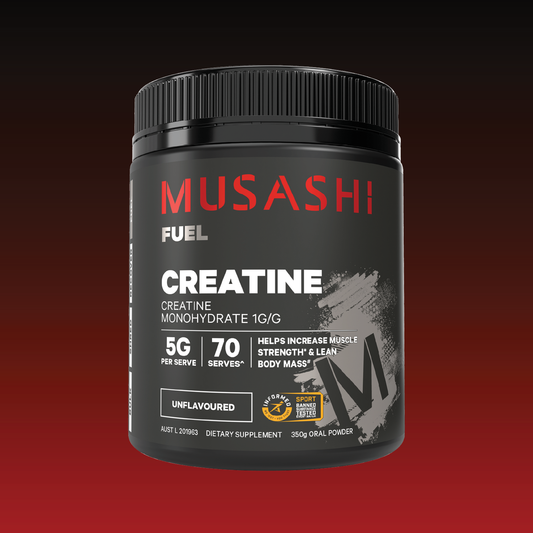
A flavoured powder can contain other ingredients, so a serve may weigh more than the creatine monohydrate in it. Musashi Creatine Monohydrate Powder shows the difference. Its Unflavoured serve is 5 g of powder, while the Berry serve is 6 g. Both provide 5 g of creatine monohydrate. 11
Research has not shown one best time to take creatine, before or after exercise. A 2022 review found there wasn't enough evidence to say whether timing it strategically makes a real difference to training results. 6
So pick a routine that helps you follow the label consistently. Having it with a regular meal or after training can act as a reminder. Neither should be treated as a timing window you have to hit. 1,6
Our guide on how to take creatine explains dosing and timing.
Do you need a creatine loading phase?
No. Loading is an optional way to fill your muscles with creatine faster. A loading phase is not necessary to benefit from creatine monohydrate supplementation. A lower daily amount can raise your stores more gradually. 1–3,5
| Research comparison | Loading followed by maintenance | Lower daily intake from the start |
|---|---|---|
| Common approach | About 20 g/day split into several doses for 5–7 days, then a maintenance dose | Commonly 3–5 g/day without loading |
| Main purpose | Fill muscle stores faster | Fill muscle stores gradually |
| Expected timescale | About one week in common protocols | About four weeks in AIS guidance |
| Practical consideration | More serves a day, and large single doses are potentially less comfortable | A simpler daily routine |
| Label directions | Not a product label direction | Still follow the exact product label |
The table sums up the research guidance. It isn't a personal plan. 1–3
In a primary study involving 31 male subjects, 20 g/day for six days raised total muscle creatine by about 20%. Taking 3 g/day gave a similar rise, more gradually, over 28 days. These results are about muscle stores. They don't promise the same performance gains for everyone. 5
If you're not training for a sporting deadline, there's no need to start with a loading phase. Talk to a qualified professional about any higher-dose approach, instead of changing a product's directions yourself. 1,2
Our dose and loading guide explains both approaches.
Is creatine safe to take long term?
The evidence generally supports that creatine monohydrate is well tolerated by healthy adults, under the conditions studied. That's not the same as proof that it's safe for any length of time, for every person or at any dose. 2,3,10
The ISSN position stand also looks at evidence on both short- and longer-term use. A 2025 analysis of reported adverse effects across 685 human trials compared creatine with a placebo. It found no significant difference in how often side effects were recorded. 2,10
That analysis covered a wide mix of people, doses, study lengths and ways of reporting side effects. It's useful evidence on reported side effects. But it doesn't show that every possible side effect was checked for, or that one approach suits everyone. 10
Kidneys are a common worry. A 2025 systematic review and meta-analysis found a modest rise in serum creatinine. But there was no statistically significant pooled difference in glomerular filtration rate (GFR), a measure of how well your kidneys filter. This doesn't show that creatine is suitable for people who already have kidney disease. 7
Creatinine: A waste product from the normal breakdown of creatine, used in blood tests that check kidney function. A change in creatinine isn't a diagnosis on its own, and abnormal results need a health professional to interpret them. 7
If you're having blood tests, tell your healthcare professional you take creatine. Don't dismiss an abnormal result as “just the supplement”.
Our guide to creatine, kidney and liver health explains what blood-test results mean.
Who should take creatine, and who doesn't need it?
Creatine is optional. The clearest reason to take it is if you're a healthy adult whose training includes resistance exercise or repeated high-intensity efforts. You don't need it to start at the gym or to be active. 1,2,4
If you eat little or no meat or fish, you may have lower creatine stores in your muscles, and more room to raise them by taking creatine. But a bigger rise in stores doesn't automatically mean a bigger improvement in every performance measure. 1,2
Creatine is relevant to women too, but how certain the research is varies between groups. A 2026 female-specific review reported possible small effects on some performance and lean-mass measures. But it rated much of the evidence as low or very low certainty. 9
If your training is mostly endurance, the case is less clear. A 2023 meta-analysis of 13 studies found no significant pooled improvement in endurance performance in trained people. That doesn't rule out a role in the sprint or strength work within some endurance programs. 1,8
If you have a medical condition, take medication, or are pregnant or breastfeeding, get personal advice from a healthcare professional. This guide is for healthy adults. It does not provide supplementation recommendations for children, teenagers or individuals receiving treatment for a medical condition. 2,3,15
Start with your goal, and the part of your training you want creatine to support. Our guide to creatine for women and older adults covers who it suits.
Powder, capsules or chewables: which creatine format suits you?
Pick a format based on what's practical for you and what the label says. Don't assume one format gives better results. Creatine monohydrate powder has the most research behind it, but that doesn't prove every capsule or chewable will give identical results. 1–3
Powder means measuring and mixing. Capsules mean swallowing a set number. Chewables mean chewing tablets and checking their other ingredients. Compare the creatine monohydrate amount on the label, the directions, the ingredients and whether it suits you, not just the number of scoops or tablets. 11–13
If you already mix a drink every day, you may prefer powder. If you don't like mixing, you may prefer capsules or chewables. That's about convenience. It doesn't mean better absorption or performance.
Check whether it suits your diet, too. The creatine itself can suit your diet while other ingredients in the product don't. Musashi Creatine 120 Capsules contain an animal product, while Musashi Creatine Chewables are suitable for vegetarians and vegans. 12,13
Our guide to creatine powder, capsules and chewables compares the three formats.
What side effects or body-weight changes should you consider?
Some people get stomach discomfort, particularly with larger single doses. Creatine can also increase your weight early on, as your body water changes. These are two different things, so they shouldn't both be called “bloating”. 1,3,15
A higher scale reading doesn't tell you whether the change is water, fat or muscle. Short-term water changes shouldn't be described as instant muscle growth. They can also matter if you compete in a weight category. 1,3 Our guide to creatine and weight explains what the scale can and can't tell you.
Controlled evidence reviewed in the creatine literature does not substantiate a general claim that creatine causes dehydration or muscle cramping in healthy studied populations. However, maintaining adequate hydration during exercise remains important, regardless of creatine use. 2,3
If you get symptoms, check the product directions. If they don't go away, get worse or worry you, see a healthcare professional. Don't assume every symptom is a normal part of taking creatine.
For more detail, read our guide to creatine side effects, safety and digestive health. If you've heard that creatine causes hair loss or acne, our articles on creatine and hair loss and creatine and acne look at what the research shows.
Should you take creatine on rest days or cycle off it?
Research maintenance protocols generally use a daily dose, rest days included. That's because the aim is to keep your muscle stores high, not to get an instant workout effect. Your product's directions are still the ones to follow. 1,2
One missed day won't empty your muscle stores. When you stop taking creatine, raised stores drop gradually over several weeks. In that same loading study, stores were back to their starting level 30 days after stopping. 5
The guidance reviewed here doesn't treat a planned “cycle” off creatine as a necessary part of normal use. That doesn't mean everyone should take it forever. Whether it suits you, how you tolerate it, your goals and health advice all still matter. 2,3
Our guide to taking and stopping creatine explains these decisions.
How do you check a creatine supplement before using it?
Start with the label: the creatine monohydrate amount, daily directions, warnings and other ingredients. Don't assume two products called “creatine” contain the same thing. A multi-ingredient formula also isn't the same as the creatine-only doses used in research. 1,11–13
For drug-tested athletes, contamination is a separate issue from whether creatine itself is allowed. Sport Integrity Australia lists creatine as permitted in sport, but warns that supplements can carry a contamination risk. 15
Batch testing can lower the risk. But it is not a guarantee of zero risk, or proof that a product works better. Informed Sport advises athletes to check the exact product and batch number, not just the brand name or logo. 15,16
Musashi Creatine Monohydrate Powder and Musashi Creatine Chewables are Informed Sport certified, which means every batch is tested for banned substances before release. 11,13,14
Before using a product, check two things: that the label fits how you'll use it, and that you can verify any certification your sport requires. If either is unclear, sort it out first.
What creatine formats does Musashi make?
Musashi offers creatine monohydrate in powder, capsule and chewable formats, and the amount of creatine in each labelled serve differs by format.
Musashi Creatine Monohydrate Powder is 100% creatine monohydrate in its Unflavoured version. It comes in Unflavoured (350 g and 600 g), Berry (420 g) and Blue Raspberry (420 g), with 5 g of creatine monohydrate per serve. The Unflavoured version is a single ingredient, with nothing else added. 11
Musashi Creatine 120 Capsules have 500 mg of creatine monohydrate per capsule. The label directions are three capsules twice daily, which provides 3 g across six capsules. 12
Musashi Creatine Chewables have 1,000 mg of Creapure® creatine monohydrate per tablet. Three tablets daily with food provides 3 g, with no water or shaker needed. They come in Berry, with 60 tablets per pack. 13
| Product detail | Powder | Capsules | Chewables |
|---|---|---|---|
| Creatine monohydrate amount | 5 g per serve | 500 mg per capsule | 1,000 mg of Creapure® per tablet |
| Labelled serve | Unflavoured: 5 g of powder; Berry: 6 g of powder | Three capsules twice daily | Three tablets daily with food |
| Daily amount on the label | 5–10 g of creatine monohydrate | 3 g across six capsules | 3 g across three tablets |
| Practical format | Measure and mix | Swallow capsules | Chew tablets, no water needed |
| Other ingredients | Unflavoured: none. Berry: contains sucralose and sulfites | Contains an animal product and sulfites | Contains sugar, sucralose and sulfites |
| Informed Sport certified | Yes | No | Yes |
These details come from the product pages and certification records. 11–14
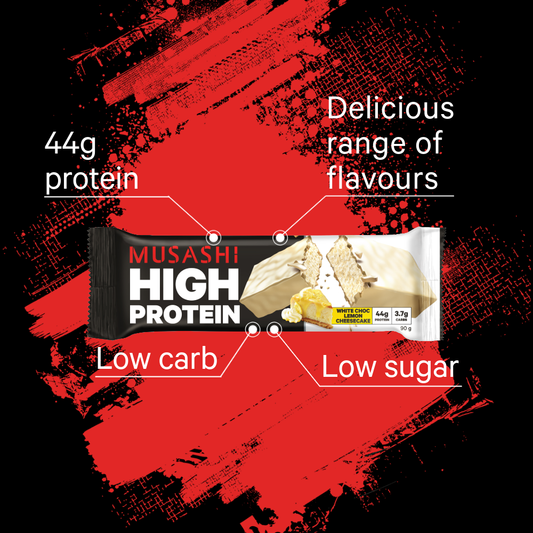
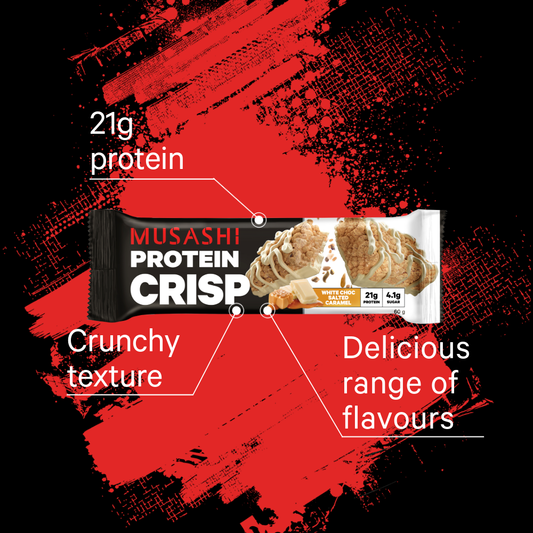
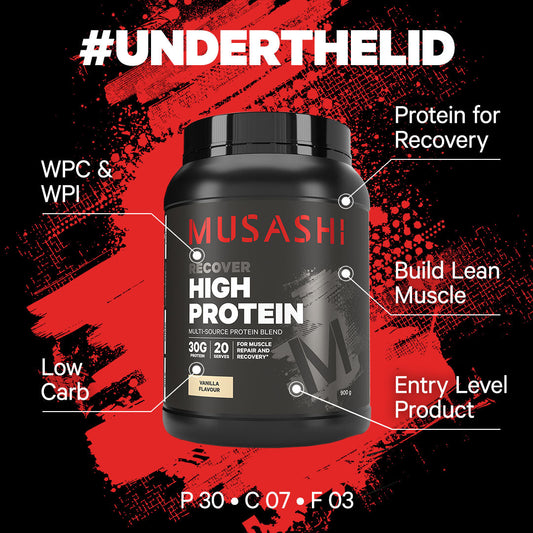
Creatine also comes in some Musashi protein products. 100% Whey + Creatine and High Protein + Creatine are protein powders, while the High Protein + Creatine Bar and Protein Crisp + Creatine Bar are protein bars. Each has 3 g of creatine monohydrate per serve or bar.
Musashi Reaper Creatine Power Matrix is a multi-ingredient powder containing creatine monohydrate, HMB, vitamin D3 and electrolytes, available in Blue Raspberry and Watermelon. Each 10 g serve has 6 g of creatine monohydrate. The studies in this guide tested creatine, not this full formula.
Pick the format that fits your routine and diet, then follow its directions. A scoop of powder, six capsules and three chewables are different serves, so don't swap them one for one.
Key takeaways about creatine
- Creatine helps your muscles quickly rebuild ATP, their energy carrier, during short, intense efforts. 1,2
- Creatine plus resistance training can improve strength. Results vary from person to person. 4
- Research commonly uses 3–5 g a day in healthy adults. 1–3
- Loading fills your muscle stores faster, but it's optional. 1,5
- Creatine is generally well tolerated by healthy adults, but that doesn't mean it suits every medical situation. 2,3,7
- Powder, capsules and chewables differ in creatine per serve, other ingredients and certification, so compare their labels. 11–16
Frequently asked questions about creatine
Is creatine the same as creatine monohydrate?
Creatine is the natural compound, and creatine monohydrate is the supplement form: creatine paired with one water molecule. Your body makes creatine and also gets it from foods like meat and fish. Creatine monohydrate has the most research behind it as a supplement. But the ingredients and directions of finished products can differ. 1–3
How long does creatine take to increase muscle stores?
How long creatine takes depends on how you take it. In a study of 31 men, 20 g/day for six days raised total muscle creatine by about 20%. Taking 3 g/day gave a similar rise over 28 days. Those results are about muscle stores, not a set date when you'll notice a difference in performance. Follow your product label. 5
Can women use creatine?
Creatine research includes women, but some results are more certain than others. A 2026 review in women found possible small effects on some performance and lean-mass measures. Much of that evidence was rated low or very low certainty. Healthy adult women should weigh up their training goals and the product directions. Pregnancy, breastfeeding and medical conditions need personal advice. 9,15
Does creatine cause weight gain?
Creatine can push your weight up when you first start taking it, because your body water can change. A higher number on the scale doesn't show, on its own, whether you've gained fat or muscle. Longer-term lean-mass changes also depend on your training. If you compete in a weight category, you should factor this in before changing your supplements. 1–3
Is creatine suitable if you have kidney concerns?
If you have kidney concerns, don't use research on healthy adults to decide whether creatine suits you. A 2025 meta-analysis found a modest rise in creatinine but no significant pooled difference in GFR, a measure of kidney filtering. However, these findings cannot be generalised to individuals with pre-existing kidney disease. Talk to your healthcare professional about supplements and abnormal results, instead of reading a blood test yourself. 7,15
References
- Australian Institute of Sport. (n.d.). Creatine. Australian Sports Commission. AIS creatine guidance.
- Kreider, R. B., Kalman, D. S., Antonio, J., Ziegenfuss, T. N., Wildman, R., Collins, R., Candow, D. G., Kleiner, S. M., Almada, A. L., & Lopez, H. L. (2017). International Society of Sports Nutrition position stand: Safety and efficacy of creatine supplementation in exercise, sport, and medicine. Journal of the International Society of Sports Nutrition, 14, 18. DOI record
- Antonio, J., Candow, D. G., Forbes, S. C., Gualano, B., Jagim, A. R., Kreider, R. B., Rawson, E. S., Smith-Ryan, A. E., VanDusseldorp, T. A., Willoughby, D. S., & Ziegenfuss, T. N. (2021). Common questions and misconceptions about creatine supplementation: What does the scientific evidence really show? Journal of the International Society of Sports Nutrition, 18, 13. DOI record
- Wang, Z., Qiu, B., Li, R., Han, Y., Petersen, C., Liu, S., Zhang, Y., Liu, C., Candow, D. G., & Del Coso, J. (2024). Effects of creatine supplementation and resistance training on muscle strength gains in adults under 50 years of age: A systematic review and meta-analysis. Nutrients, 16(21), 3665. DOI record
- Hultman, E., Söderlund, K., Timmons, J. A., Cederblad, G., & Greenhaff, P. L. (1996). Muscle creatine loading in men. Journal of Applied Physiology, 81(1), 232–237. DOI record
- Candow, D. G., Forbes, S. C., Roberts, M. D., Roy, B. D., Antonio, J., Smith-Ryan, A. E., Rawson, E. S., Gualano, B., & Roschel, H. (2022). Creatine O'Clock: Does timing of ingestion really influence muscle mass and performance? Frontiers in Sports and Active Living, 4, 893714. DOI record
- Kabiri Naeini, E., Eskandari, M., Mortazavi, M., Gholaminejad, A., & Karevan, N. (2025). Effect of creatine supplementation on kidney function: A systematic review and meta-analysis. BMC Nephrology, 26, 622. DOI record
- Fernández-Landa, J., Santibañez-Gutierrez, A., Todorovic, N., Stajer, V., & Ostojic, S. M. (2023). Effects of creatine monohydrate on endurance performance in a trained population: A systematic review and meta-analysis. Sports Medicine, 53(5), 1017–1027. DOI record
- Lin, Y., Zhu, W., & Hong, B. (2026). Effects of creatine supplementation on exercise performance, physiological outcomes, and body composition in females engaged in exercise or training: A systematic review and multilevel meta-analysis. Frontiers in Nutrition, 13, 1921827. DOI record
- Kreider, R. B., Gonzalez, D. E., Hines, K., Gil, A., & Bonilla, D. A. (2025). Safety of creatine supplementation: Analysis of the prevalence of reported side effects in clinical trials and adverse event reports. Journal of the International Society of Sports Nutrition, 22(Suppl. 1), 2488937. DOI record
- Musashi. (n.d.). Creatine Monohydrate Powder Unflavoured or Flavoured. Musashi product page.
- Musashi. (n.d.). Creatine 120 Capsules. Musashi product page.
- Musashi. (n.d.). Creatine Chewables. Musashi product page.
- Informed Sport. (2026). Banned Substance Tested Supplement List. Certified-product list.
- Sport Integrity Australia. (n.d.). Creatine use in sport. Creatine and supplement-risk guidance.
- Informed Sport. (n.d.). Athletes. Exact-product and batch-verification guidance.
The information in this article is for educational purposes only and is not intended as medical advice. Always read the label and follow the directions for use. If symptoms persist, consult your healthcare professional. Musashi products are formulated for healthy adults; consult a healthcare professional before use if you have a pre-existing medical condition, are pregnant or breastfeeding, or are taking medication.